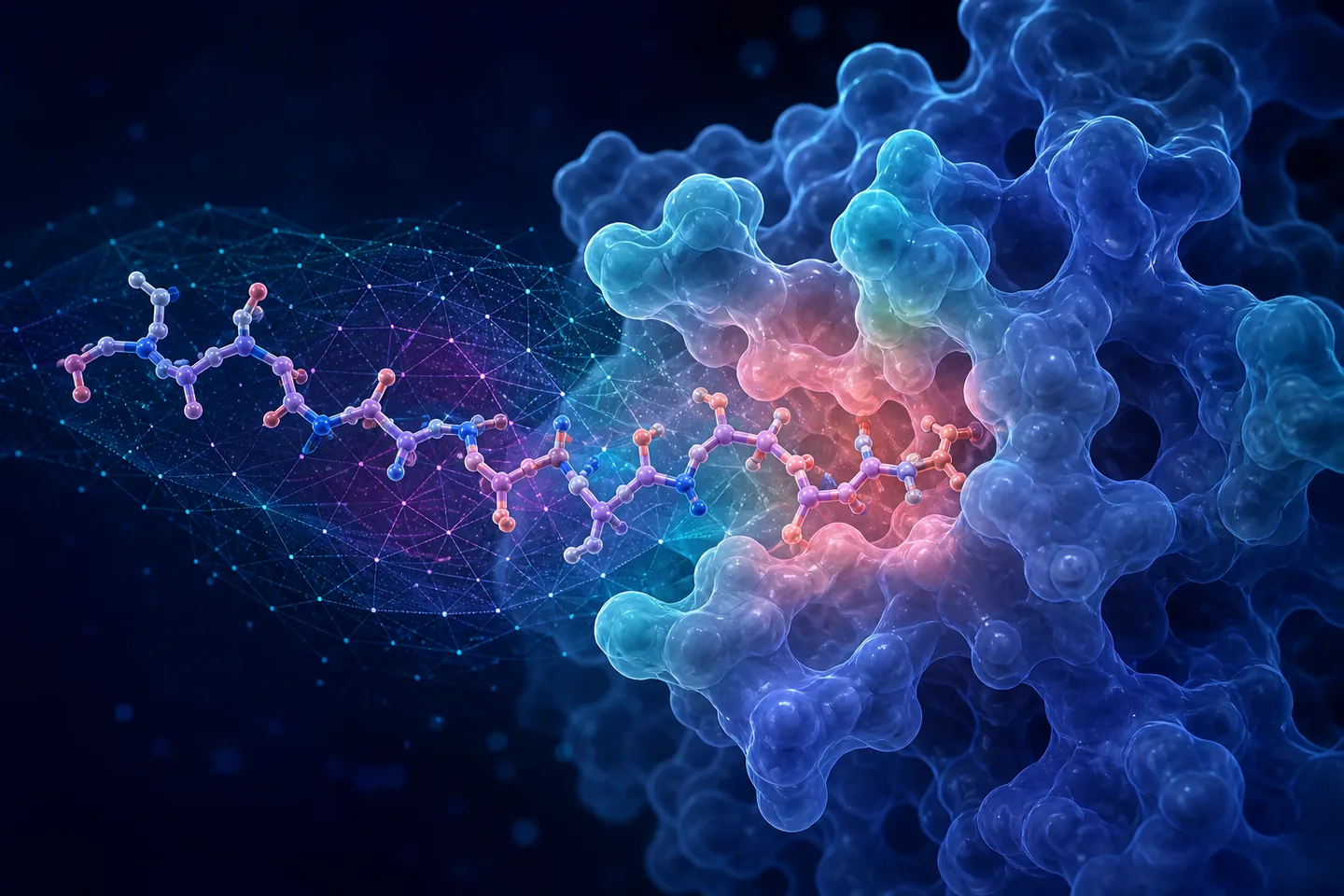
A team at Xiamen University has introduced VITAL, a system for analysing interactions between short peptides and proteins. Its dual-channel architecture combines representations from a protein language model with an encoder that captures spatial proximity at the binding interface.
On the reported benchmarks, the best AUC reached 0.87. The authors also report interface-mapping precision above 60% at near-residue resolution and a continuous binding-strength measure that correlated significantly with experimental data. Selected newly predicted interactions were tested experimentally.
This is a computational tool with limited laboratory validation, not evidence that a new drug is effective or safe. Results depend on training-data quality and available structural features; performance on independent biological systems and in blinded prospective experiments still needs confirmation by other teams.
A possible use is to prioritize peptide candidates, locate probable binding sites and flag unwanted interactions earlier. The model and data are public, which supports independent testing, but they do not replace laboratory measurements or subsequent development.
On an optimistic editorial estimate, methods like this could speed up specialized research pipelines within 2–5 years if they hold up on external prospective datasets. Moving from a computational candidate to an approved therapy normally takes much longer, and this study cannot provide a reliable timetable.



Be the first to open the discussion.