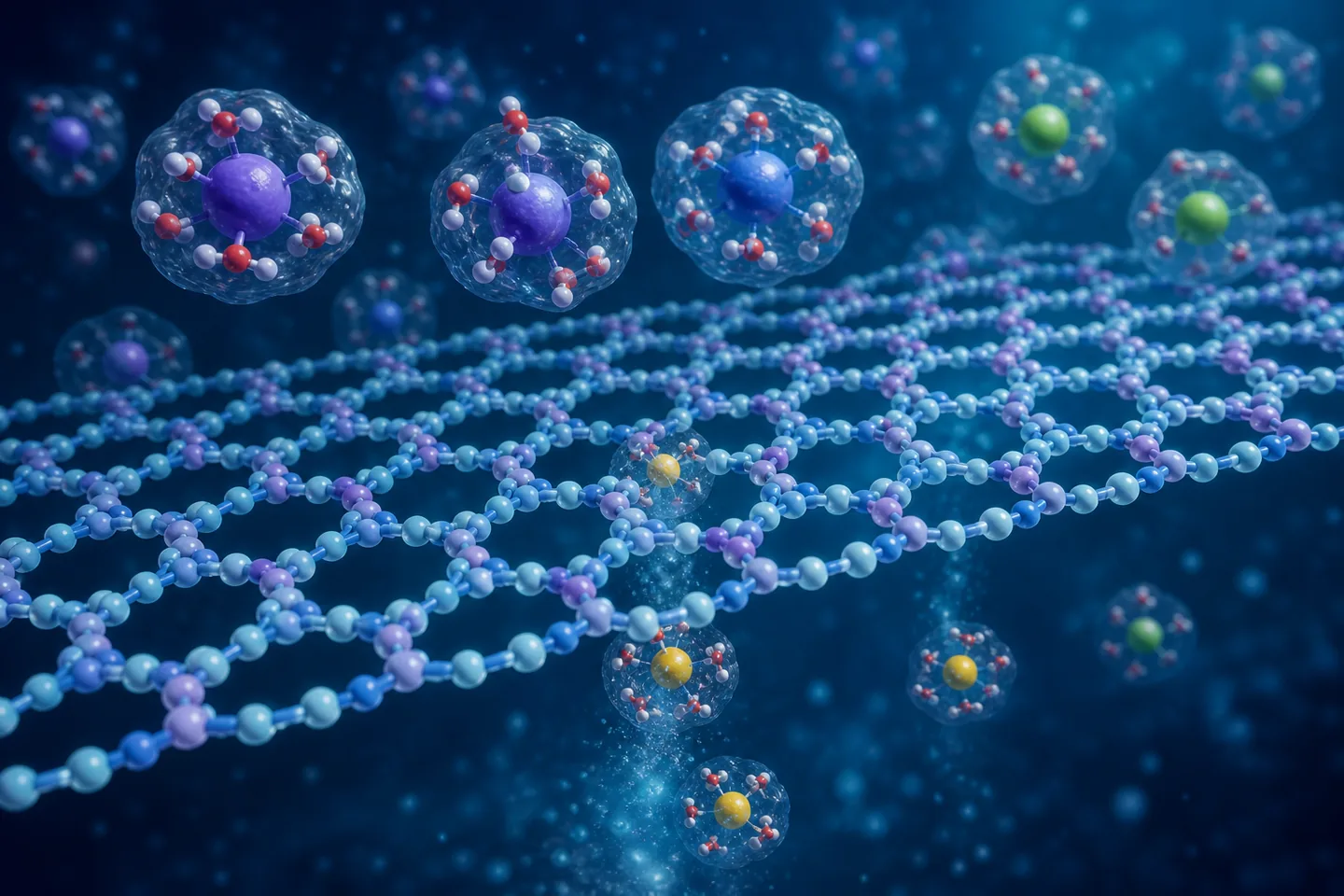
Researchers built a monolayer covalent organic framework membrane whose pores separate monovalent ions in water. In experiments it combined high lithium selectivity over sodium and potassium with high ion flux.
The mechanism is more than simple size sieving. The study attributes transport to attractive and repulsive interactions between ions bound in the pore and ions moving through it, which organize the hydration layer. Lithium can therefore pass without the energy-intensive step of complete dehydration.
What has been demonstrated is laboratory transport through a particular membrane, not a finished lithium-extraction process. The public abstract does not establish long service life, defect-free large-area production or performance in complex real brines.
A possible use is selective lithium recovery from brines or recycling streams and other membrane processes for battery materials. Reaching that point requires independent replication, stability and fouling tests, measurements in real mixtures and scalable manufacturing.
On an optimistic editorial estimate, specialized pilot modules could emerge in 4–8 years if selectivity and flux survive outside clean laboratory solutions. Broad industrial deployment would probably take longer and cannot yet be dated reliably.
Be the first to open the discussion.